

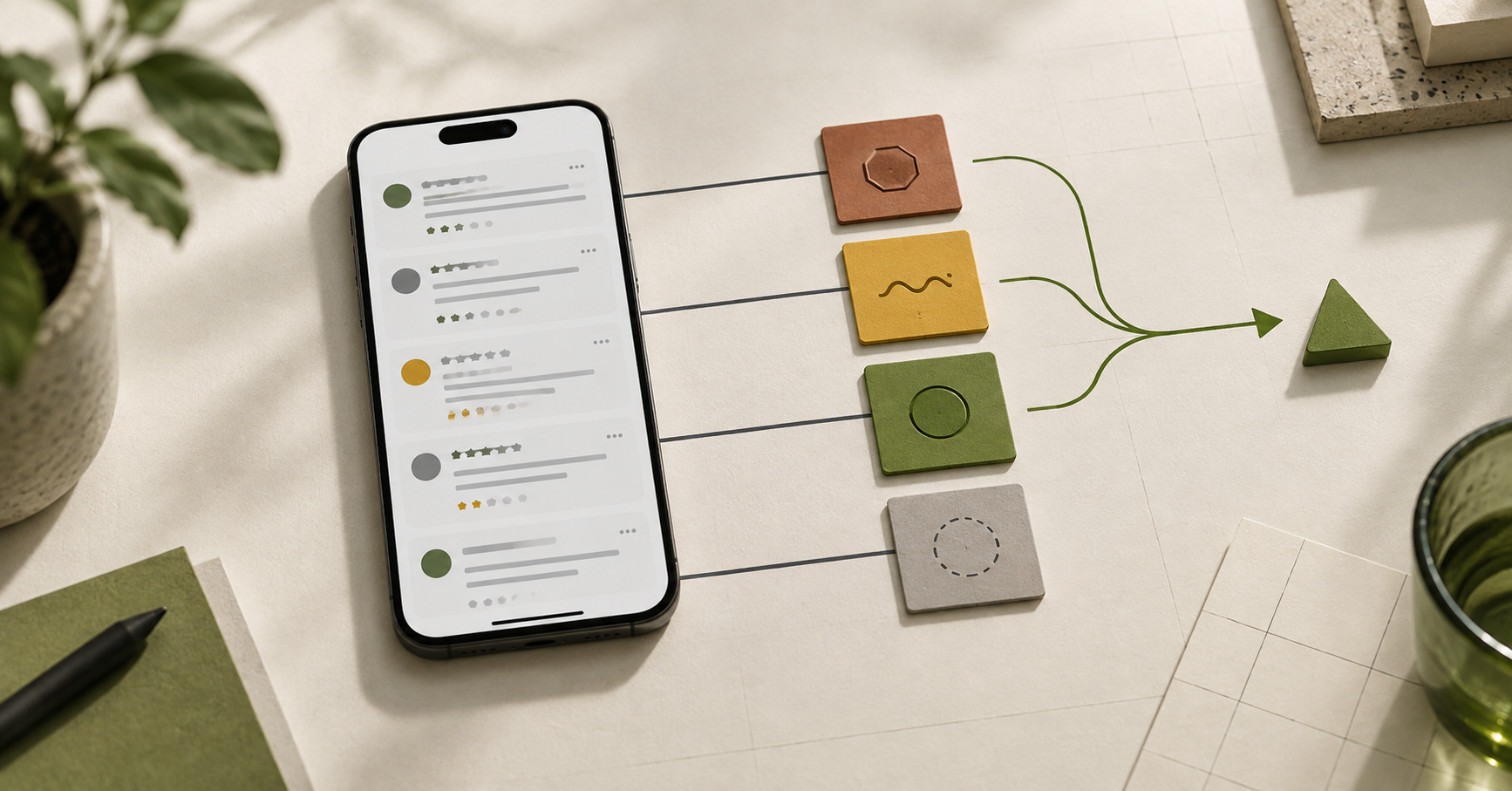
App reviews can reveal where people struggle, but they are not a ready-made product roadmap. The useful work is turning recurring feedback into testable product questions before choosing a fix.
Reviews may point to a confusing task, a missing capability, a reliability issue or a customer expectation the product never intended to meet. Those are different problems.
Start with a review ledger, not a list of quotes
Capture the review date and product version where available, the user task, exact complaint, suspected problem type and any related support, analytics or research evidence. A low rating tells you an experience disappointed someone; it does not establish why.
Sort each review before you prioritize it
Reliability or defect
A crash, failed payment, lost data, incorrect result or login failure contradicts what the product should do. Route it to engineering triage first.
Usability friction
The product may work, but the person cannot find, understand or complete an intended task. This is a candidate for expert review and, where risk is meaningful, usability testing.
Missing capability or policy mismatch
A requested feature, price, eligibility or permissions rule is a product and commercial decision, not automatically a usability failure.
Context you cannot yet classify
Keep vague reviews in the ledger but do not create a backlog item until another source adds context.
Turn recurring language into a question the team can answer
Replace “improve onboarding” with a question such as: at which setup step do new customers lose the information or confidence needed to continue? Planning around explicit questions helps a team choose an appropriate method. GOV.UK’s research guidance recommends defining the question and selecting activities that can provide reliable answers.
Add corroboration before you change a high-impact flow
Use the smallest useful second source: support context, analytics, privacy-safe session review, moderated usability testing or an expert UX audit. Moderated usability testing observes people attempting a specific task; an expert review can identify likely friction, but neither proves every user behaves the same way.
Prioritize decisions, not the loudest complaint
- Affected task
- Evidence strength
- Impact if unresolved
- Remaining uncertainty
- Next smallest step: defect triage, expert review, usability test, policy decision or design work
Pengreen helps startup and SaaS teams turn scattered feedback into a prioritized next step. Explore Pengreen’s UX audit approach or talk through a startup/SaaS product challenge.
 EN-US
EN-US PT-BR
PT-BR